Written by Ozan Solmaz, Lioba Heimbach and Jason Milionis
This blog post is based on Active Liquidity On Chain: Evidence from PropAMMs Across Chains.
Liquidity providers on traditional AMMs such as Uniswap are passive and suffer from adverse selection. The price in these pools only moves through trades. Thus, when the external reference price moves, liquidity providers get picked off on their stale quotes. To combat this, propAMMs emerged in 2024. In a propAMM, a single operator quotes from its own inventory and reprices actively, using proprietary pricing, sizing and risk management. Today, propAMMs carry significant volume across many chains including Monad.
What benefits does this new design bring, both for liquidity providers and for retail users? Do propAMM operators really have an advantage over passive liquidity providers, and if so, where does this advantage come from? Can propAMMs offer tighter quotes to retail users? To answer these questions, we measured a full year of propAMM activity on Solana, Base and Monad, from September 2025 to August 2026. We also decoded the closed-source on-chain logic of Tessera, the largest propAMM on Base.
TL;DR
- PropAMMs are more profitable than passive liquidity providers. Two seconds after a fill, propAMMs earn 0.37 bps on Solana, 1.19 bps on Base and 1.69 bps on Monad, while passive liquidity providers on AMMs lose 0.22, 0.62 and 2.06 bps.
- We trace this outperformance to four sources: cheap and frequent repricing, pricing by counterparty, arbitrage against AMMs, and spoofing.
- PropAMMs offer retail tighter quotes than AMMs on all three chains, e.g., 1.62 against 8.60 bps on Monad.
- Users bear the cost of spoofing: Tessera's fee changes tend to leave traders worse off than quoted.
How does a propAMM work?
In an AMM, the price follows from the pool's reserves, so it only moves when someone trades. In a propAMM, the operator sets the price instead, and its pricing logic is proprietary, as the name indicates. The operator can move its quotes at any time by sending an update, without a swap. These updates are cheap, since the operator only changes a few parameters rather than every quote. Tessera on Base, for example, places each level of its book at a fixed multiplier from a single anchor price and spread. Updating these two values moves the whole book.
On top of the quoted price, a propAMM can charge penalties. These can depend on the age of the quote, the origin of the taker, the priority fee of the transaction and its relative position in the block with respect to updates.
The propAMM landscape
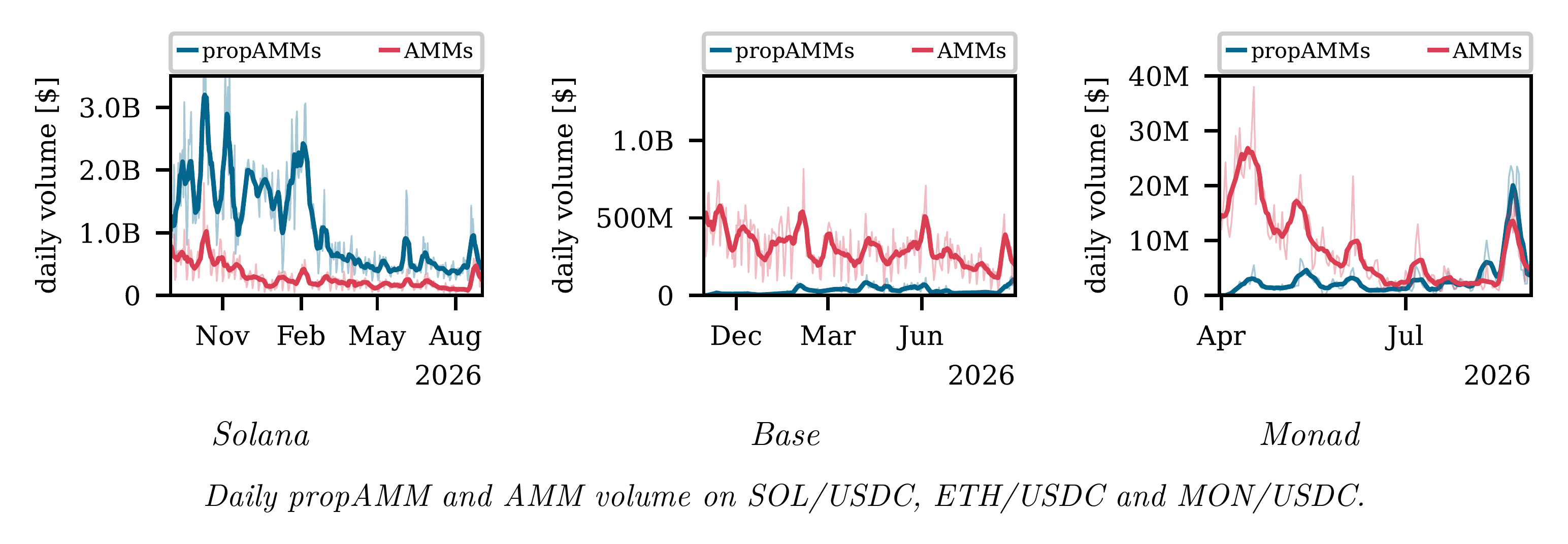
PropAMMs traded \$1.12 billion of SOL/USDC per day on Solana on average over the sample year, against \$292 million on AMMs. Volume fell on both venue types, and propAMM volume dropped from \$1.82 billion per day in the first three months to \$527 million in the last three. Base followed later, with its first propAMMs launching on October 30, 2025. Their ETH/USDC volume grew from \$9.5 million per day in their first three months to \$29.6 million in our last three, and their share against AMMs rose from 2.4% to 10.9%. Monad's first propAMM launched in early April 2026. Since then, MON/USDC volume on propAMMs grew from \$2.1 million to \$3.9 million per day, and their share against AMMs rose from 12.5% to 45.7%.
Do propAMM operators outperform AMMs?
To measure whether propAMMs outperform AMMs, we look at markouts, i.e., the profit or loss on a fill evaluated against the reference price at a fixed horizon after execution. We evaluate every fill against the Bybit microprice and weight fills by their notional. Positive values indicate that the liquidity provider gained.
The figure below plots the markouts of AMMs on Solana, Base and Monad. While the magnitude differs across the three chains, the shape is identical. On all three chains, the markouts are strongly positive ahead of the fill, at 5.34 bps on Solana, 3.95 bps on Base and 7.76 bps on Monad five seconds before, and they steeply turn negative around the fill. AMMs only reprice once a trade has occurred. Thus, when the reference price moves, liquidity providers get picked off on their stale quotes.

For propAMMs, the curves invert the AMM pattern. An AMM is in the money before the fill and loses after it, whereas a propAMM is out of the money before the fill and earns after it. On Solana and Monad, the markout starts at −0.69 and −2.65 bps five seconds before the fill, rises steeply into the fill and stays positive afterwards. Base is the exception, as its markout never turns negative. Notably, in aggregate, fills do not arrive at random points in time but follow moves in the reference price. Yet the propAMM still earns after the fill. This is consistent with the propAMM repricing as the reference moves, so that it is not the one being picked off.

The result: propAMMs are more profitable than passive liquidity providers. Two seconds after a fill, propAMMs earn 0.37 bps on Solana, 1.19 bps on Base and 1.69 bps on Monad, while passive liquidity providers on AMMs lose 0.22, 0.62 and 2.06 bps.
Where does this outperformance come from?
We trace the outperformance to four sources.
Cheap, frequent repricing
PropAMMs update their quotes by sending update transactions, e.g., changing the anchor price, and such an update is far cheaper than a swap. On Solana, a median update consumes between 485 and 676 compute units against at least 16,938 for a swap. An update thus costs more than an order of magnitude less. On Base and Monad, an update is 5 to 15 times cheaper than a swap. Across the three chains, transactions are by default ordered by priority fee per unit of compute. This lets propAMMs secure early block positions cheaply.
Tessera Implementation Insight. On Base, Tessera pays 2.37 times its base fee to land a price update, but only 0.18 times for a book update, i.e., it pays for position only when the update is time critical. Tessera also updates its prices more often during times of high volatility. Across five-minute windows, the correlation between its price-update count and ETH realized volatility is 0.56.
Pricing by counterparty
Five of the six largest Solana propAMMs offer tighter spreads to aggregator flow than to non-aggregator flow. We measure the spread on round trips, i.e., two opposite fills of similar size on the same pool with no quote update in between. The size of the gap varies by propAMM. GoonFi charges non-aggregator flow 3.59 bps more and SolFi V2 1.58 bps more. For BisonFi and Tessera, the difference is only 0.10 bps.

Tessera Implementation Insight. On Base, Tessera splits addresses into classes: it whitelists some, penalizes others and blacklists a few entirely. Volume-weighted, a trade costs 0.44 bps at the margin before fees and 1.95 bps after. Whitelisted addresses pay an effective marginal cost of 0.78 bps, while penalized addresses pay 4.96 bps.
Arbitrage against AMMs
When the reference price moves, propAMMs reprice and AMMs do not, so arbitrageurs trade between the two. Before such an arbitrage, the reference price has already moved by a few bps. The propAMM fills at its updated quote, so it roughly breaks even on these legs on Solana and Base and earns 1.55 bps on Monad. This resembles CEX–DEX arbitrage with the propAMM taking the place of the CEX, except that both legs execute atomically on chain.
Tessera Implementation Insight. On single fills, Tessera earns 1.29 bps two seconds after the fill, but without its penalties it would have lost about 1 bp. Some of these fills are likely attempted CEX–DEX arbitrage against Tessera. Instead of taking a loss on a stale quote, Tessera appears to identify that it is being adversely selected and charges penalties high enough to turn a profit on single fills.
Spoofing
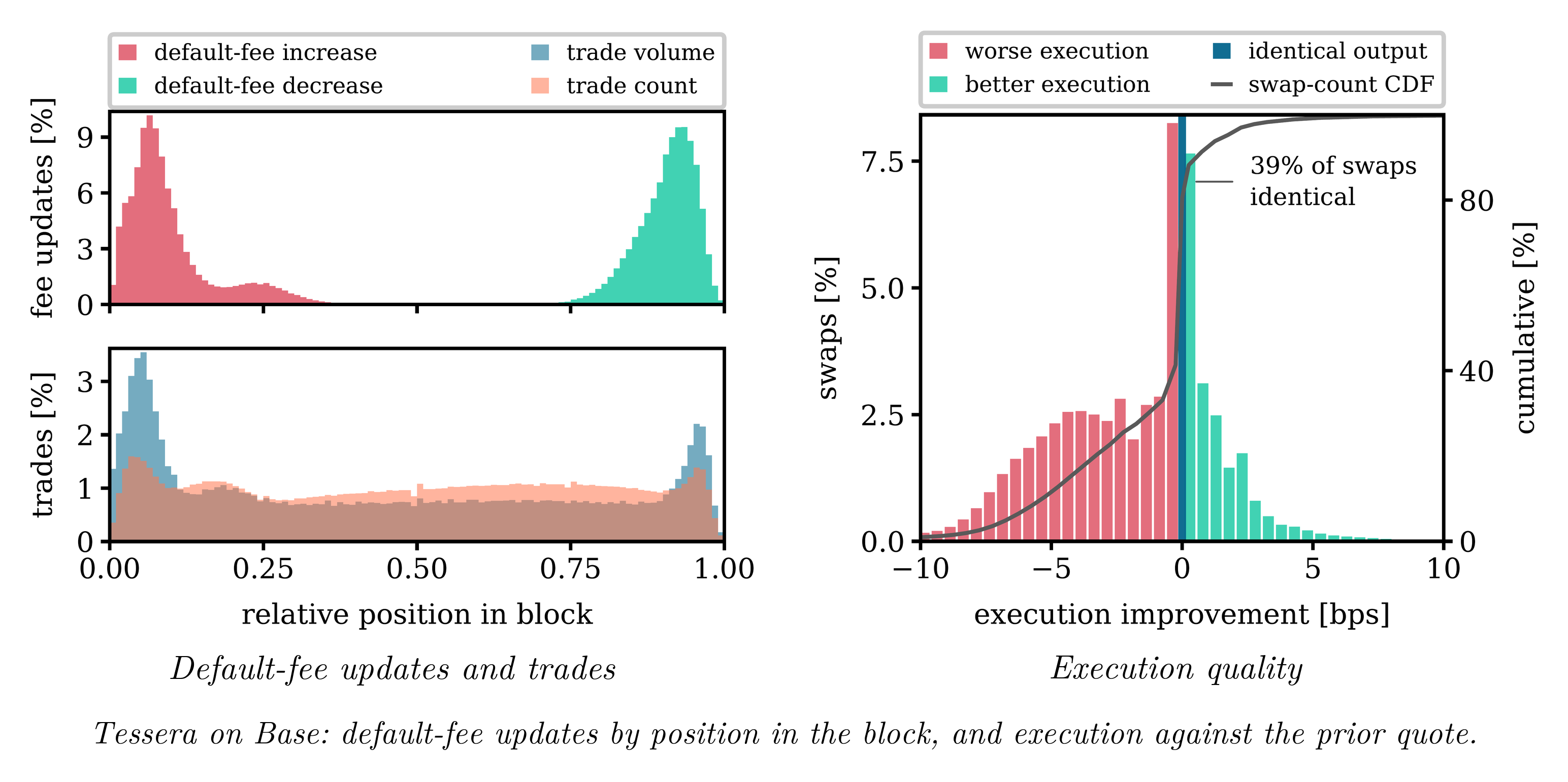
Generally, aggregators route on the quote from the end of the previous block. This creates a game in which propAMMs compete to post the best quote at the end of the block, since that is the quote that wins the routing. On Base, Tessera raises its default fee early in the block and lowers it again at the end. Fee increases cluster in the first tenth of the block and decreases in the last tenth, so aggregators read the lower fee. We compare each trade's execution with the quote the aggregator saw. When Tessera updated its price in between, trades were about as likely to do better as worse. When the default fee had changed, 94% of the affected volume did worse.
Tessera Implementation Insight. The figure below shows one example block on Base. The dashed lines are Tessera's bid and ask without fees and the solid lines include the default fee. D marks a default-fee change, S a swap and P a price or spread update. Tessera raises the default fee from 0 to 538 ppm before the first swap of the block, which widens the spread after the default fee from 2.78 to 13.54 bps. After the last swap it resets the fee to zero, and the spread narrows from 13.70 to 2.94 bps. The block therefore ends with the tight spread that many aggregators read, while every swap in it paid the wider one.

Do retail users benefit?
The second question we ask is whether propAMMs can offer users tighter quotes as a result of their profitability. To isolate retail flow, we call a fill quiet when the reference price moves less than 1 bp between five seconds before and one second after it. Quiet fills carry no information the maker has to price against, which is what we expect of retail.
The answer is yes. On quiet fills, propAMMs take 0.26 bps on Solana, 1.26 bps on Base and 1.62 bps on Monad two seconds after the fill, while AMMs take 2.59, 1.38 and 8.60 bps. Quiet fills also make up a larger share of propAMM volume, at 32%, 43% and 17% on Solana, Base and Monad, compared with 9%, 16% and 8% on AMMs. The higher profitability over AMM liquidity providers therefore does not come at the expense of retail.

Looking ahead
Overall, we find that propAMMs benefit both their operators and retail users. They avoid the losses of passive liquidity providers and offer retail tighter quotes. However, users currently bear the cost of spoofing, since aggregators route on the quote from the end of the previous block. An on-chain router that queries each venue inside the swap transaction would close this gap and route each trade on the price it actually receives. MRC-17, a shared routing interface for propAMMs, is a step in this direction.
