On high-throughput, low-fee blockchains, a qualitatively different form of MEV has emerged: rather than targeting specific opportunities identified off-chain, searchers flood the chain with speculative transactions whose profitability is resolved only at execution time. In 2025, these speculative transactions consumed around a fourth of block gas on major rollups, yet only a small proportion of these probes resulted in an actual trade. As a result, many consider them spam MEV. The response from blockchain designers has been largely reactive and ad-hoc, without a principled understanding of why spam emerges, what its actual impact is, how much any given intervention actually reduces it, or what the tradeoff is between spam reduction and including genuine users caught in the crossfire.
We develop a principled framework to understand spam MEV and explore these questions. This post summarizes our paper, which models spammers in a competitive equilibrium, and derives how block capacity, gas fee floors, and transaction ordering jointly determine spam volumes.
What Is Spam MEV?
Much of the MEV discussions to date have focused on Ethereum's Layer 1, where the dominant strategies — sandwich attacks, cyclic arbitrage, liquidations — have historically been precise and targeted. A searcher identifies a specific opportunity through off-chain computation, constructs a transaction to capture it, and submits it with high confidence of success. Competition is mediated through builder auctions: only the winning bid makes it on-chain, and losing bids are largely filtered out before execution.
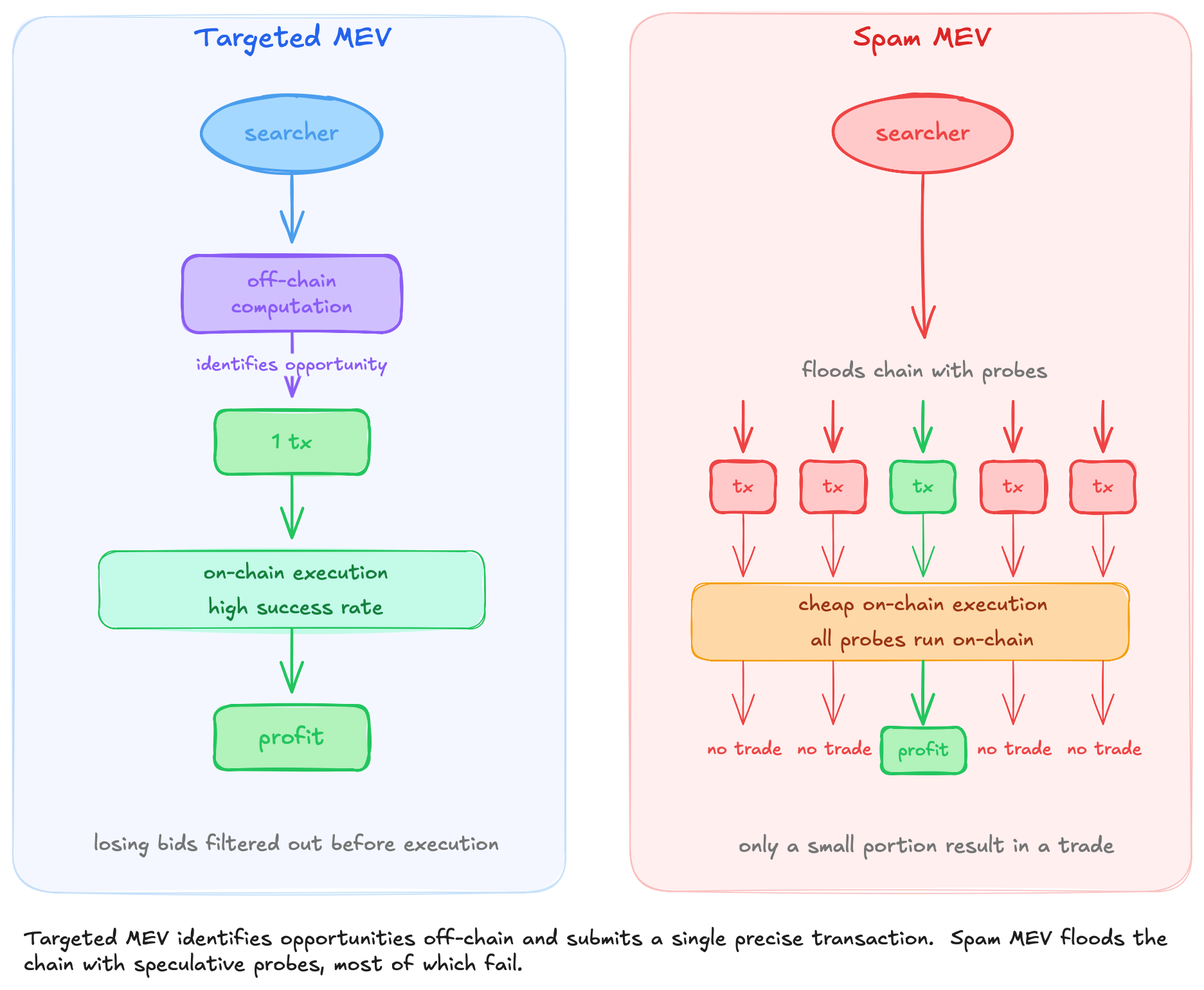
Spam MEV is qualitatively different. Rather than targeting a specific opportunity identified off-chain, searchers submit large volumes of speculative transactions whose profitability is resolved only at execution time. Both the detection and execution of opportunities reside in on-chain smart-contract logic: each transaction probes whether a profitable opportunity exists at the moment it executes and, if so, captures it. When no opportunity is found, the transaction may revert or simply consume gas without producing a trade. On Base and Optimism, only 6–12% of these speculative probes result in an actual trade.1
This mode of extraction thrives under three conditions common to modern high-throughput chains:
- Low transaction fees. Failed probes are cheap, so repeated probing is profitable even at low success rates.
- Fast block times. Sub-second block times leave insufficient time to observe state changes and submit targeted transactions before the next block, favoring continuous speculative submission over deliberate off-chain computation.
- No public mempool. Rollups use centralized sequencers. Monad and Solana on the other hand forward transactions directly to the block producer. Without a mempool, targeted extraction is harder, pushing searchers toward speculative probing.
First documented on Solana2, spam MEV has since spread to Base, Optimism, Arbitrum, and other high-throughput chains. It is not a marginal phenomenon. In our sample, spam consumed around a fourth of block gas on Base and Arbitrum throughout 2025.
The Industry's Reactive Response
By 2025, spam MEV had become hard to ignore. Spam was documented consuming more than half of block gas on major rollups,1,3,4 and the community debated how harmful it is in particular to scaling.4 Blockchain indexing services eventually announced they would discontinue free API access for Base, citing infrastructure costs driven by the high transaction volumes.5 Chains started acting, but largely on intuition.
Base, the largest Ethereum Layer 2 in terms of TVL, is the most instructive case. Following Ethereum’s Dencun upgrade in March 2024, which drastically reduced Layer 2 data availability costs, Base progressively raised its block gas target. Spam gas grew disproportionately faster than non-spam gas throughout this period, absorbing the majority of the added capacity: 122x from Dencun to its peak in April 2025; non-spam gas grew 11.2x.
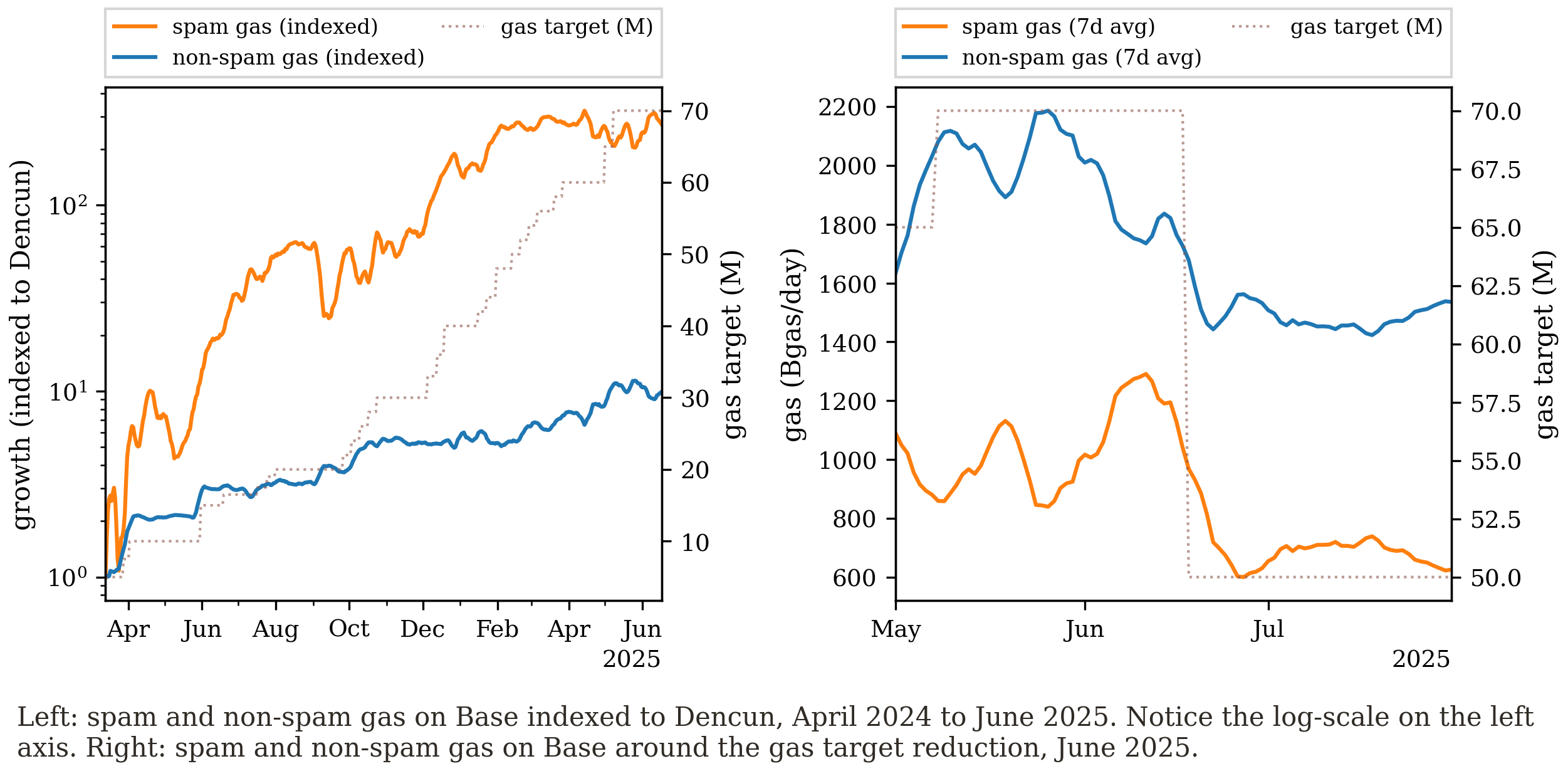
When the community took notice, Base reduced the gas target from 70M to 50M in June 2025. Spam gas fell by 34% in the 30 days after the change, but non-spam gas fell 24% too. Both declined, but spam absorbed a larger share of the reduction.
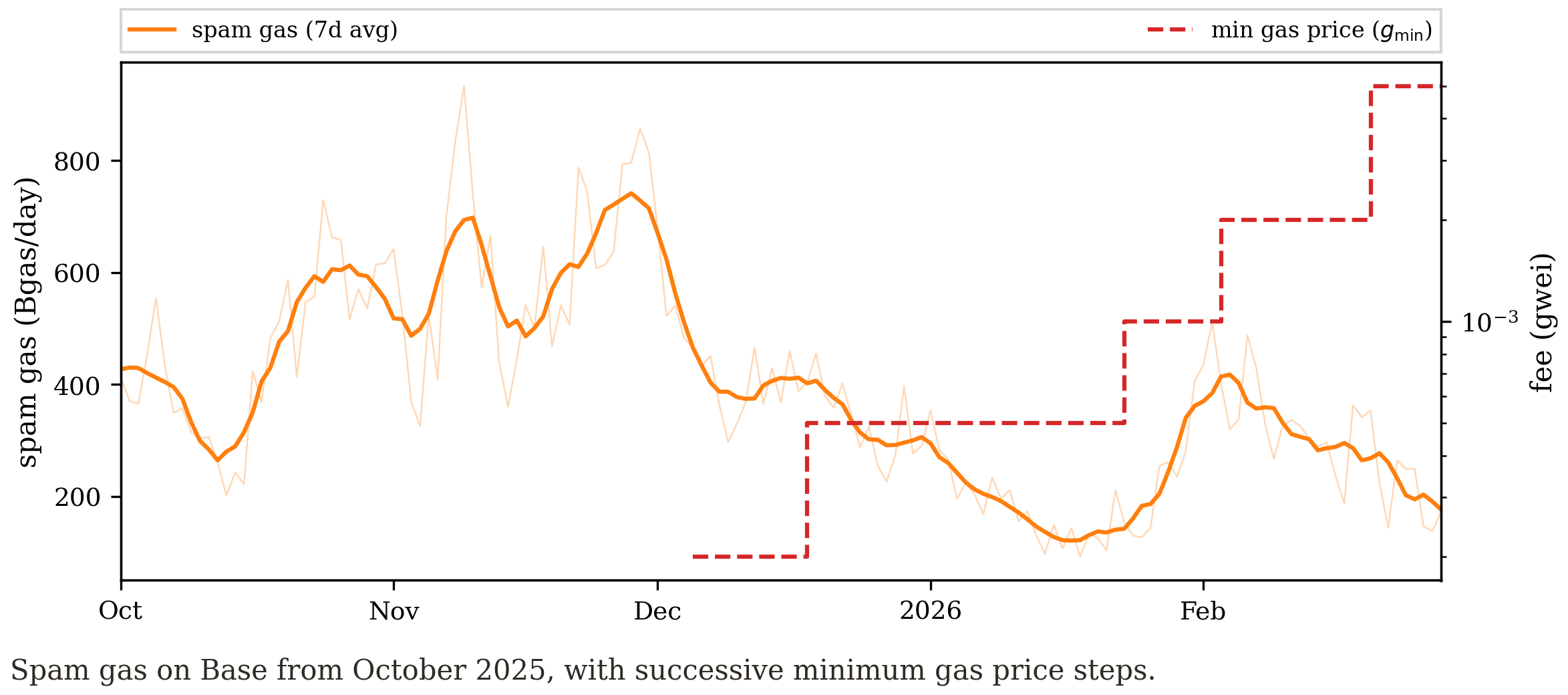
Base then introduced a protocol minimum gas price in December 2025 to further reduce spam and raised it through several steps. Spam's share fell sharply, from around 26% to below 9% over the following months.
Other chains also moved to tackle spam. Arbitrum raised its minimum gas fee, and Aptos introduced one, both explicitly citing spam reduction as the rationale. Newer chains have designed their parameters with spam in mind from the start. Monad launched with a non-trivial minimum gas price and a fee model that charges transactions based on their gas limit rather than gas actually consumed. Spam transactions typically reserve large gas allocations but use only a fraction when they fail; charging for reserved gas directly targets this asymmetry.
These interventions share a common intuition: the cost of curtailing spam — some users priced out, some throughput forgone — is worth bearing to reduce the burden spam places on the network. But the responses have been chain-specific and ad-hoc. Each, in its own way, adjusted one of three design parameters that blockchain designers have at their disposal, each of which influences both spam and genuine users:
- Block space limit Bmax. The block space limit affects inclusion costs. When Bmax is low relative to transaction demand, competition for inclusion drives up gas prices; when it is large enough to accommodate all transactions, gas prices fall.
- Minimum gas price gmin. A blockchain can impose a floor on the gas price per transaction, independent of block space availability. Without it, the equilibrium gas price approaches zero when capacity exceeds demand, resulting in a disproportionately high volume of spam. Higher values of gmin increase costs when block capacity is slack, affecting both spam and non-spam transactions.
- Transaction fee mechanism. The fee mechanism affects transaction submission behavior. Charging based on gas limit rather than gas used increases the cost of speculative transactions and can thereby deter high-volume probing. The mechanism also governs the ordering of transactions within a block; priority-based ordering, for example, affects the resulting spam volumes.
Our goal is to provide a principled understanding of how these levers interact, to predict the cost of any given intervention for genuine users. We hope that this framework can help guide protocol designers in reducing spam.
A Framework for Spam Equilibrium
With our framework we study how the above levers jointly determine equilibrium spam volumes. This allows us to characterize the tradeoffs for user welfare, validator welfare, and network infrastructure.
We model spam bots as rational actors competing for on-chain opportunities under a competitive equilibrium. This means that more spam enters the system until the marginal utility of additional spam is zero. We start with a simple model that assumes random transaction ordering, which is intentionally minimal and mimics first-come-first-served ordering on low-latency blockchains, before extending the analysis to priority fee ordering. In this baseline, all included transactions pay the clearing price: the lowest bid among included transactions.
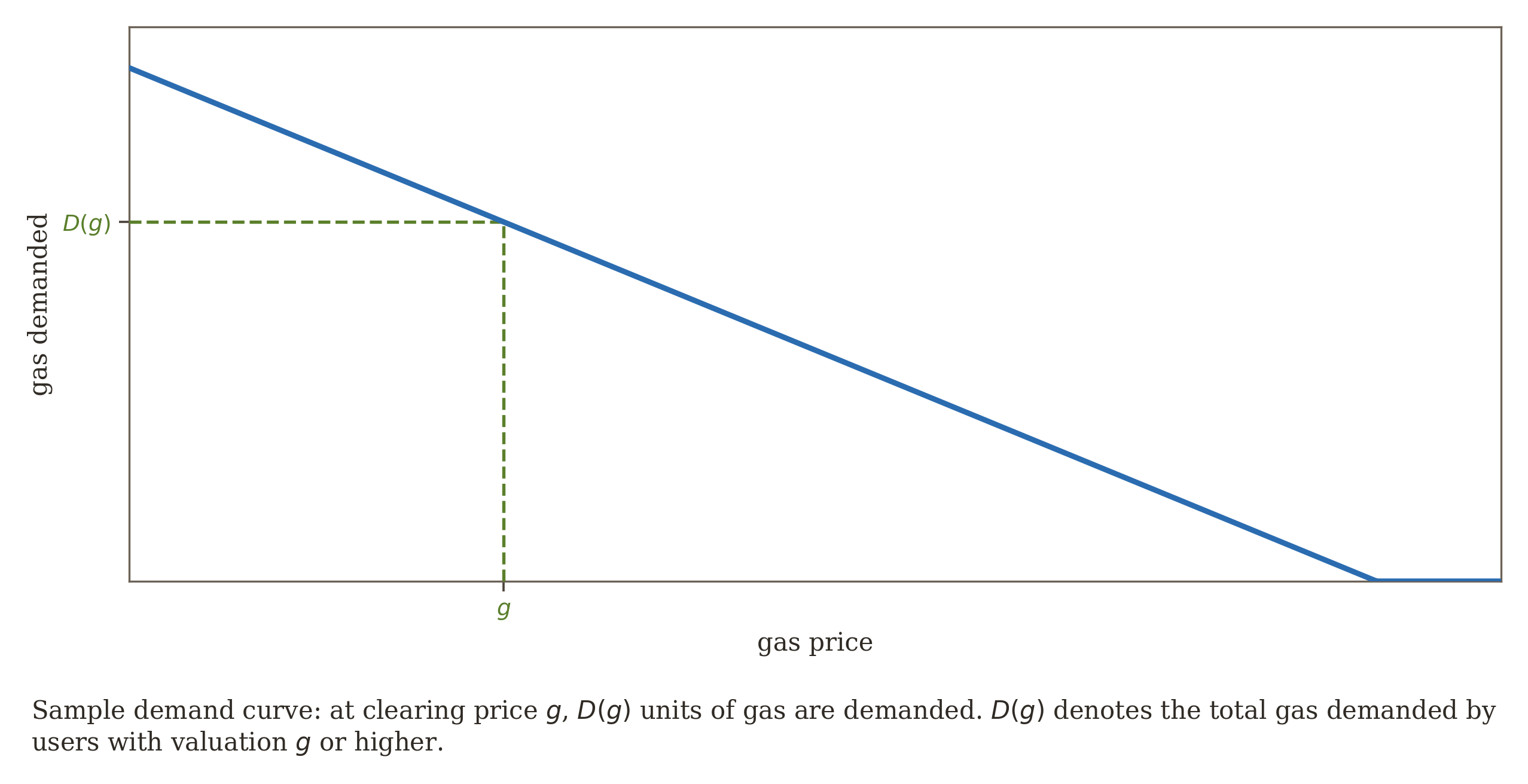
The figure above shows a sample demand curve: as the gas price rises, fewer users want to transact, and only those with valuations above the clearing price are included in the block. User transactions create a single arbitrage opportunity per block, which the first spam transaction sequenced after it captures. Note that whenever we plot figures in this post, we use a linear demand curve for tractability; qualitatively similar results hold for an exponential demand curve.
Three Regimes
The equilibrium takes one of three forms depending on how block capacity compares to user demand:
- No spam. When blocks are small, demand for the limited space pushes gas prices up. The fee per transaction exceeds the expected opportunity value, so spam bots do not enter.
- Congested regime. As block capacity grows, gas prices drop enough that spam becomes profitable. Spam enters and competes with users for the limited block space, pushing gas prices higher than they would be without spam. The equilibrium spam volume depends on block capacity, user demand, and the size of the MEV opportunity.
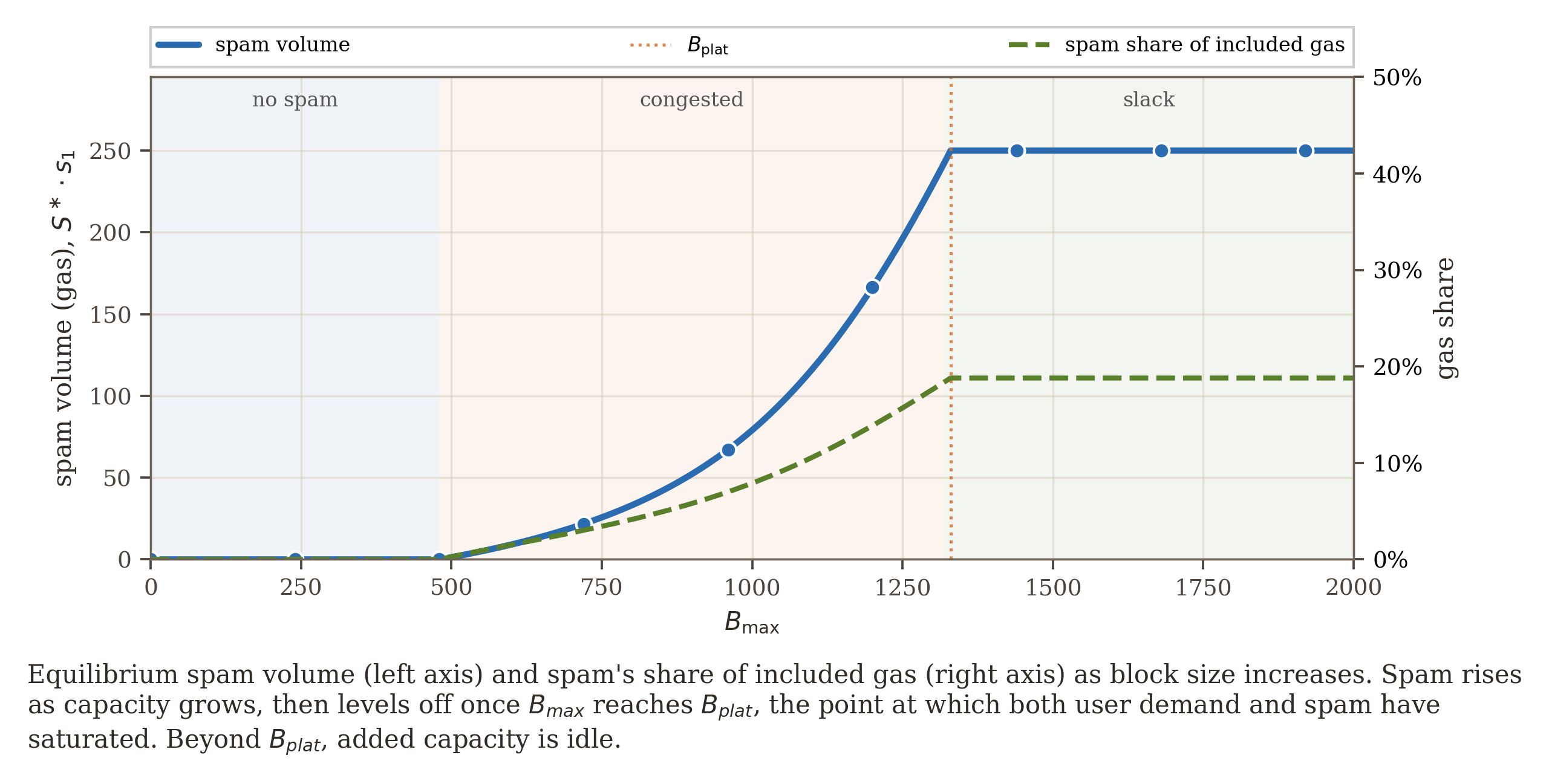
- Slack regime. At some point, block capacity is large enough to fit both user demand at the floor price and all the spam that remains profitable at that price. We call this threshold Bplat. Beyond it, spam no longer crowds out users, the gas price sits at gmin, and adding further capacity changes nothing.
The figure below shows this progression: as block capacity grows through these regimes, spam volume and its share of included gas rise alongside it.
How Spam Affects Users, Validators, and the Network
To assess the impact of spam, we compare two worlds with the same design parameters: the realized world with spam and a counterfactual world without it. We measure the difference along three dimensions.
User welfare is the aggregate surplus of all users, i.e., the total value users get from their transactions minus the fees they pay. The figure below illustrates this in the congested regime: at the spam-free clearing price g0, user welfare is the full shaded area under the demand curve. Spam drives the clearing price up to g*, shrinking that area and generating a welfare loss equal to the lighter region between the two prices.
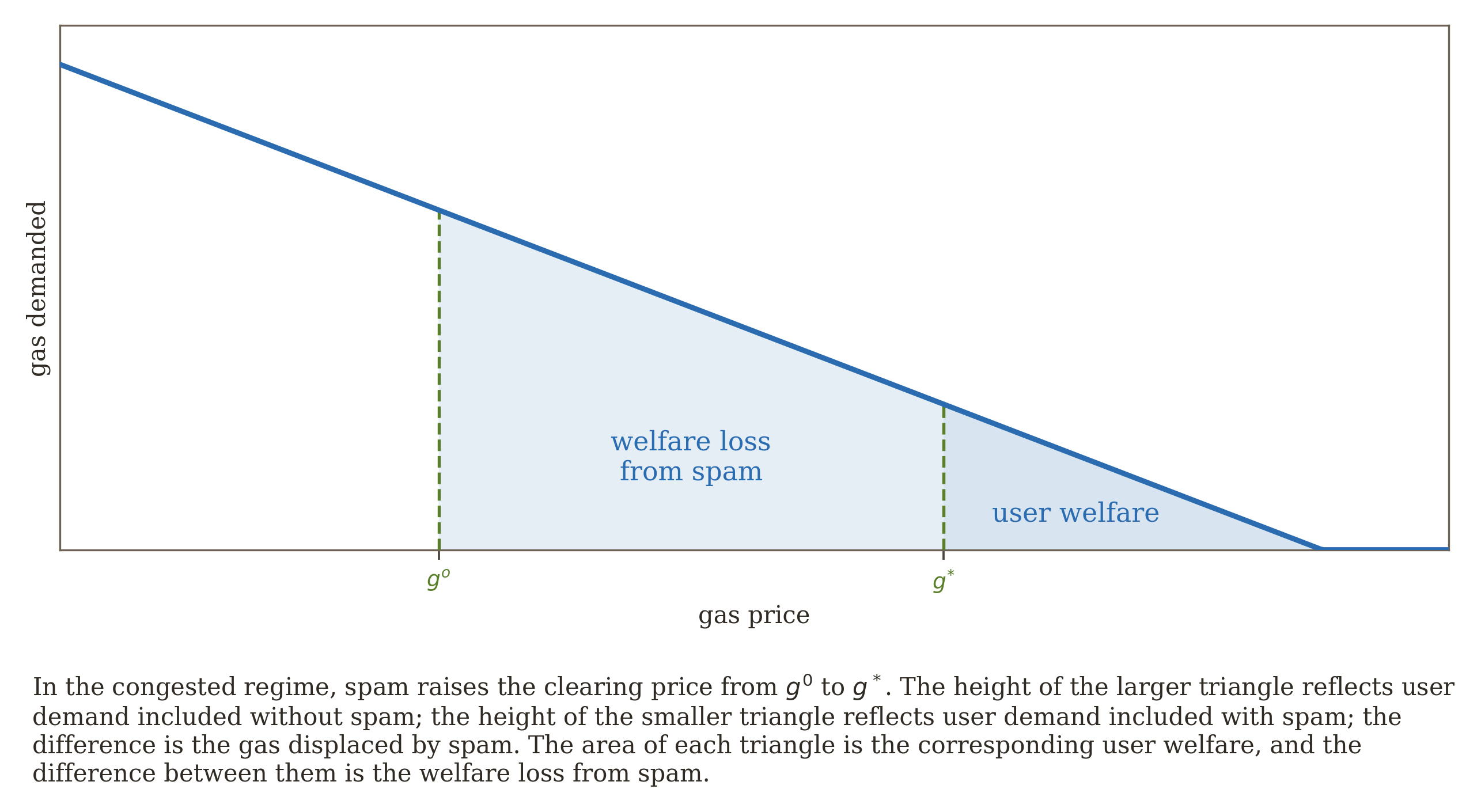
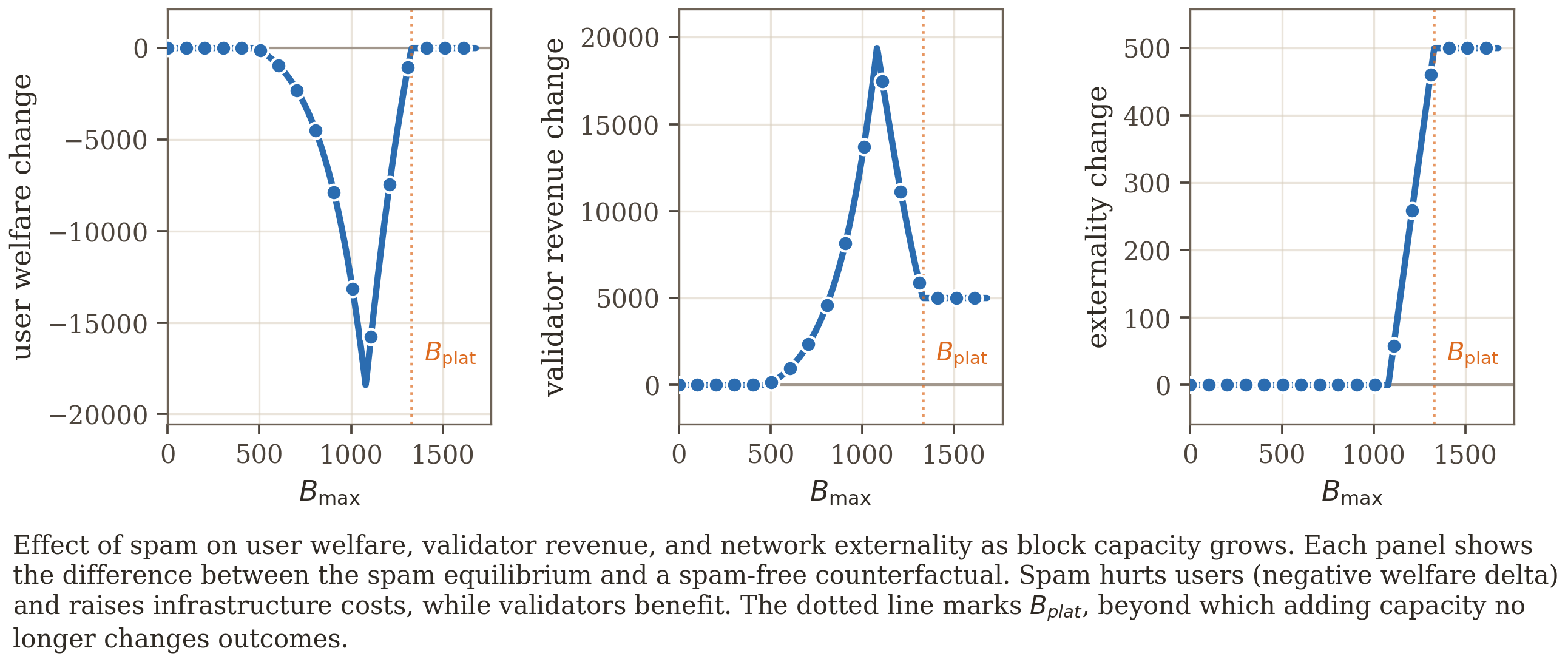
Importantly, spam never increases user welfare compared to the spam-free world. Since all transactions pay the same clearing price, spam hurts users both by displacing them from the block and by raising the price everyone pays. The welfare loss peaks when block capacity is just large enough to include all users willing to pay gmin in a world without spam.
Validator revenue is the total fees collected from all included transactions, both users and spam. Spam never decreases validator revenue, and can increase by either filling otherwise-empty block space (generating fees from gas that would have gone unused) or pushing up the gas price, increasing fees from all transactions. The parameter regime where users are most harmed by spam is also where validators gain the most from it.
Network externality is the cost borne by the broader ecosystem for provisioning block capacity and processing transactions, i.e., bandwidth, execution, storage, and the hardware requirements. Spam never decreases network externality, and when it enters, it adds execution workload and rarely executes a trade.
The tension is clear: spam hurts users and raises infrastructure costs, but it also generates revenue for validators. The figures below show these deltas as a function of the block capacity.
A Favorable Tradeoff: Marginal Capacity and Spam
The welfare and externality analysis above reveals a useful structural property: the share of each additional unit of block capacity that goes to spam is strictly increasing in Bmax. At moderate block sizes, most marginal capacity serves users. But as Bmax grows toward Bplat, each successive unit is increasingly absorbed by spam rather than users.
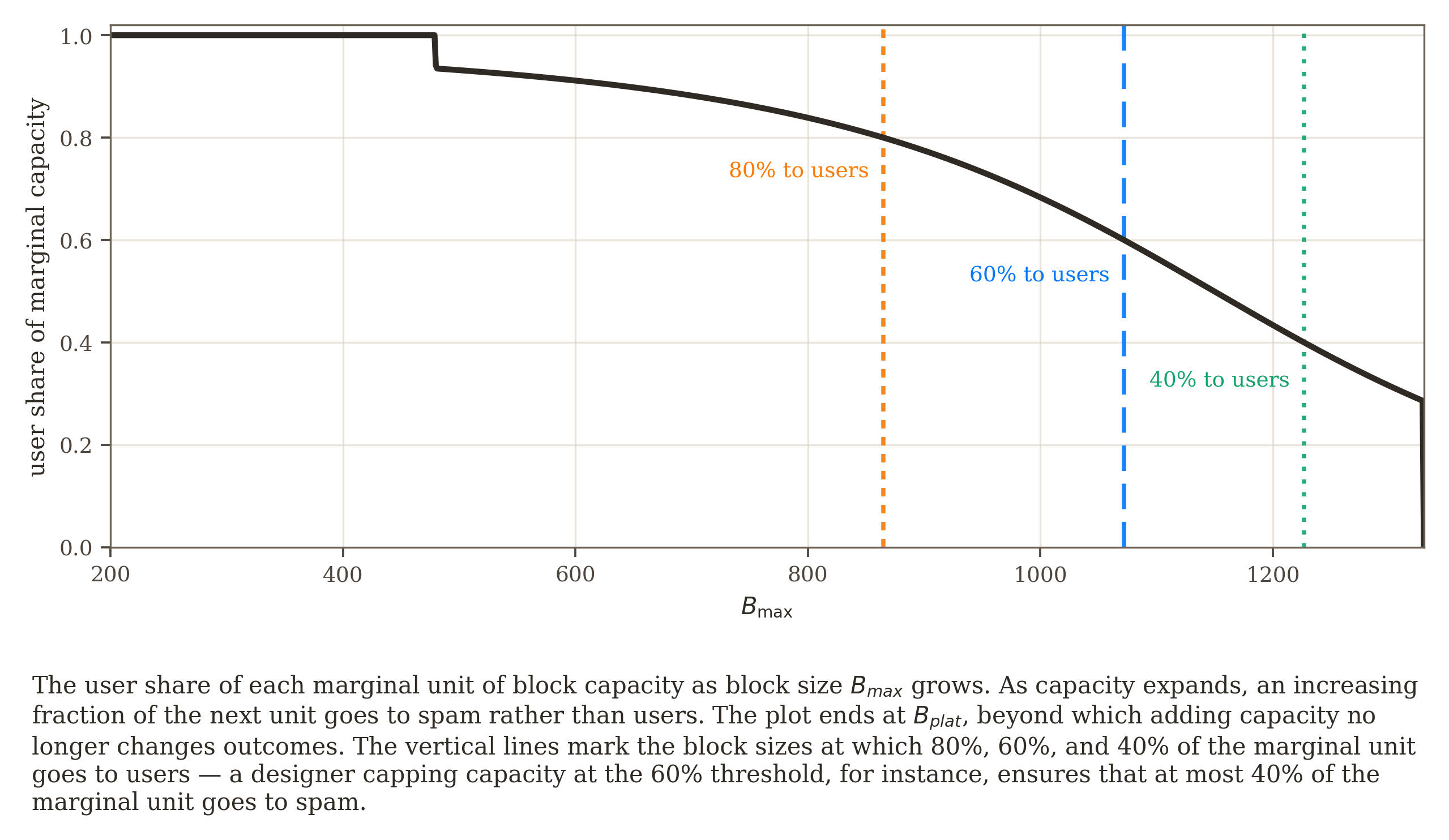
This creates a favorable tradeoff, and one that improves the closer Bmax gets to Bplat. Because spam's share of marginal capacity is strictly increasing, the last units of capacity a designer chooses not to provision are the most spam-heavy. As the figure shows, a designer can choose a threshold for the minimum fraction of marginal capacity that must go to users. Cutting Bmax just before Bplat therefore removes a large amount of spam and lowers network externality while costing very little in user welfare.
The minimum gas price gmin provides a complementary lever. When gmin was previously low or absent, the equilibrium gas price can approach zero in slack blocks, creating conditions for high spam volumes. Raising it would price out spam bots, while gmin remains negligible for genuine users whose valuations are higher.
Does Transaction Ordering Help?
On some high-throughput chains, transactions are ordered close to arrival time rather than by gas price. In our base model, we approximate this as random ordering within the block, since the position a transaction lands in is effectively independent of what it bids. Under this baseline, a spam bot pays the same price regardless of where it lands.
Priority fee ordering (PFO) changes this. When transactions are ordered by gas price, getting an early position in the block requires outbidding everyone who wants that position. Under random ordering, all positions in the block cost the same, so spam is uniformly cheap. Under PFO, a spammer that wants an early block position must pay the higher inclusion price of that sub-block, making spam more expensive than under random ordering.
We extend our equilibrium framework to an approximate PFO model: blocks divided into sub-blocks, each sub-block ordered by bid price, with random ordering within sub-blocks. As the number of sub-blocks grows, this approaches true priority ordering.
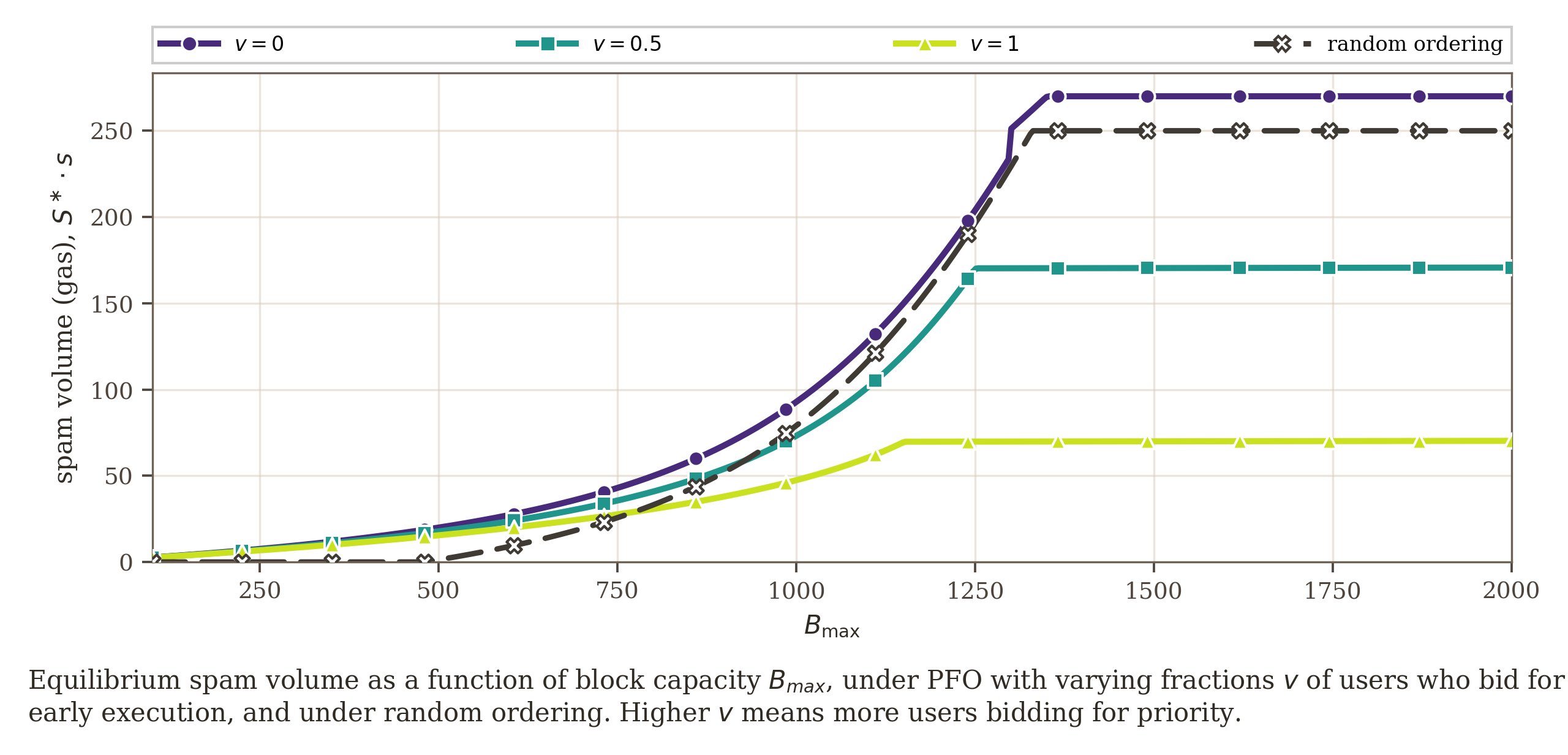
The effect of PFO on spam comes from the price separation it creates across sub-blocks. We parameterize user behavior by v, the fraction of users who bid for early execution, as opposed to those who bid only for inclusion. When v is large, many users compete for priority, the price gap between early and late sub-blocks widens, and spammers must pay more to place transactions near the top of the block. This makes it harder for spam to spread across the block and lowers equilibrium spam volume.
As the figure below shows, higher v leads to substantially less spam. When v is low, most of the block clears at the common inclusion price and the price separation that deters spam largely disappears. At v = 0, PFO can even slightly increase spam in our model, because sub-blocks give spammers more control over placement while paying only the cheap inclusion price.
The model also predicts where spam ends up inside the block. When many users pay for priority, spam is pushed toward later and cheaper sub-blocks rather than being spread uniformly through the block. When few users do, the block contains a larger region that clears at the common inclusion price, and spam can extend further toward early positions. Thus, PFO helps only when enough user demand is actually competing for priority.
How Does Spam Behave When User Demand Grows?
So far, we have treated user demand as fixed. But a natural question for blockchain designers is: what happens as user demand grows and block capacity is increased to accommodate it? Does spam capture an ever-larger fraction of blockspace, or does its share stabilize? Flashbots' thesis that MEV fundamentally limits scaling4 has been particularly influential in framing this concern.
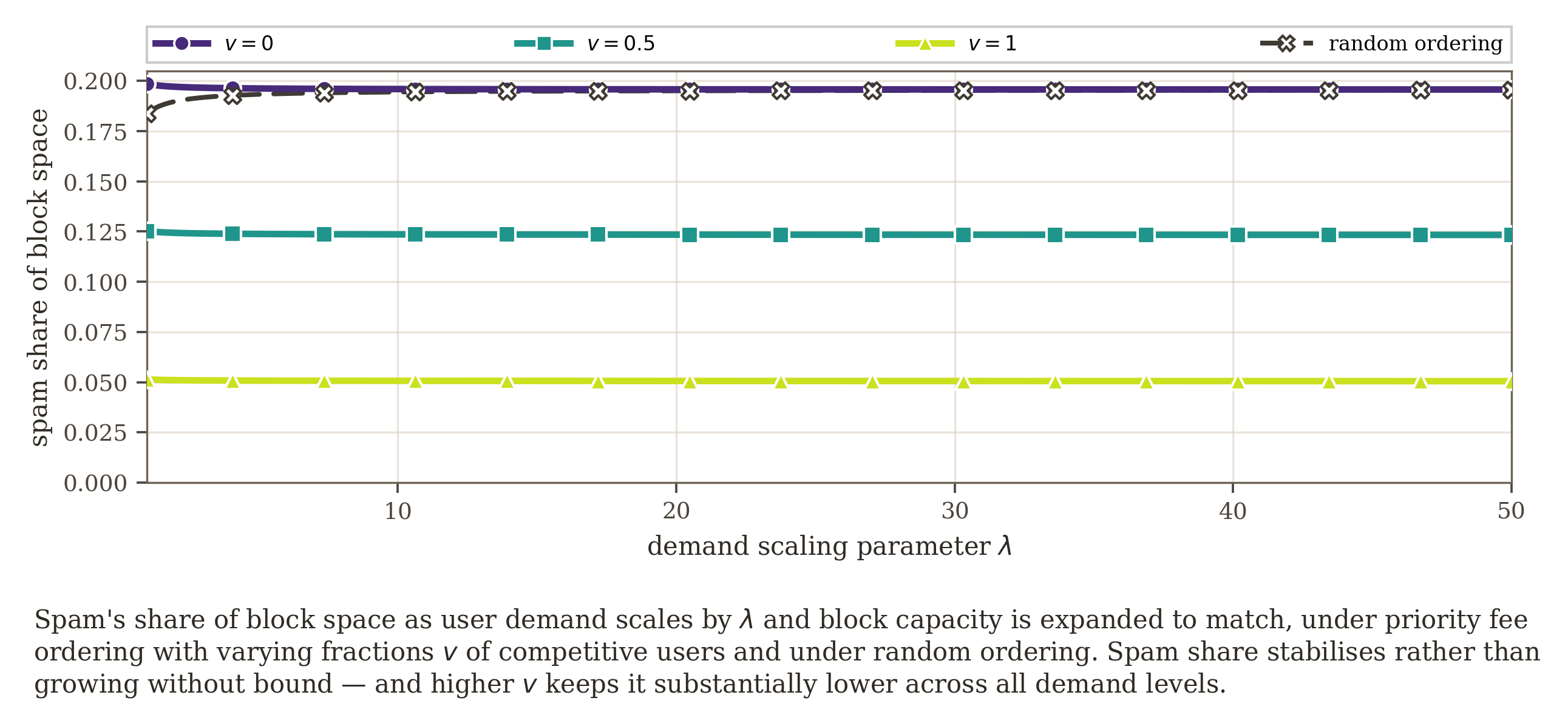
This question matters because MEV opportunities grow with user activity. Using data from Base and Arbitrum, we estimate that the total size of MEV profit grows approximately linearly with non-MEV trading volume. We then use this empirical relationship to study what happens when user demand scales by a factor λ and block capacity is increased accordingly. Concretely, at every gas price, λ times as many users want to transact, so the entire demand curve scales up proportionally.
As the figure below shows, spam's share of block capacity increases initially but then settles at a bounded level rather than growing indefinitely. It plateaus at a sizable but bounded level. Spam remains a meaningful presence, but it does not compound without bounds as the chain grows. PFO further lowers the plateau, with the effect again depending on how many users compete for priority (v).
Empirical Validation
We complement the theoretical analysis with empirical case studies from Base, using daily observations from January 2024 to February 2026. The data confirms several predictions from our framework.
Spam absorbs a disproportionate share of marginal capacity. When Base increased its gas target after Dencun, spam grew far faster than non-spam gas. When Base later reduced the gas target, spam fell more than non-spam gas. Both directions confirm the favorable tradeoff identified in our analysis: marginal block capacity disproportionately serves spam, so adjusting it has a larger effect on spam than on genuine users.
Raising gmin prices out spam while leaving most users unaffected. When Base introduced and progressively raised a protocol minimum gas price starting in December 2025, spam's share of total gas fell sharply while non-spam gas remained stable or grew. Without a floor, the equilibrium gas price approaches zero when capacity exceeds demand, creating the conditions for disproportionately high spam volumes. A non-trivial gmin prevents this.
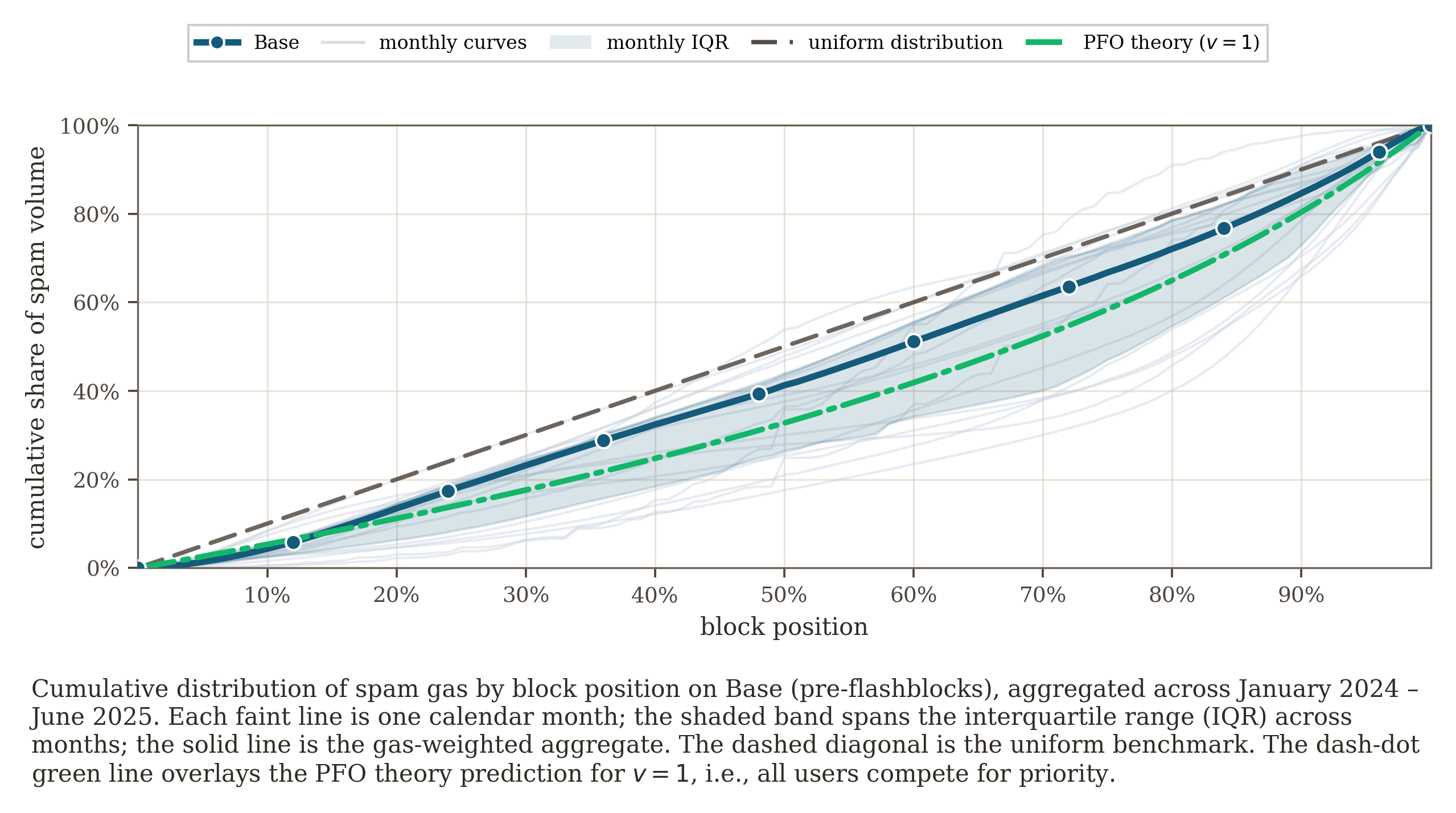
Spam clusters toward the end of blocks on Base. On Base, which uses priority-based ordering, we study where spam transactions appear within blocks. As the figure below shows, spam is concentrated toward the end of the block: only 41% of spam gas is consumed before the median block position. This is consistent with our theoretical predictions that spammers cluster later in the block. Empirically, the distribution lies between a uniform distribution and the prediction of our PFO model when all users bid only for inclusion (v=1).
Conclusion
The industry's response to spam MEV has been largely reactive. Our framework provides the missing analysis: it explains why spam emerges, how design parameters shape its volume, and what are the tradeoffs between spam costs and user welfare. The central insight is that spam disproportionately occupies the margin — as block capacity grows, each additional unit increasingly serves spam rather than users. Well-chosen reductions in capacity or increases in the fee floor therefore remove more spam than they cost in user welfare. Priority fee ordering and demand scaling reinforce this picture: priority fee ordering makes spam more expensive, and spam's share stabilizes as chains grow in accordance with user demand.
Check out the paper for the full analysis, including the formal equilibrium derivations, welfare characterization, and empirical case studies.
